|
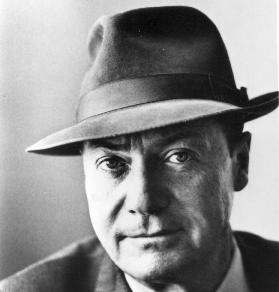
Ross Macdonald
If
any one person seemed destined to become an author, it was mystery
novelist Ross Macdonald. Born Kenneth Millar on December 13, 1915, in Los
Gatos, California, Millar also published various works under the name of John Macdonald and John Ross Macdonald.
He is most known for a series of novels starring Lew Archer, a tough but
compassionate private investigator whom Macdonald named after Miles Archer, Sam Spade's
dead partner in Dashiell Hammett's novel, The Maltese Falcon (1930).
Macdonald spent most of his early life around Vancouver,
British Columbia, Canada, where his father worked for a time as a harbor
pilot before deserting the family, leaving them in dire financial straits.
Macdonald's mother suffered from typhoid fever and couldn't support her
child and herself, so Macdonald spent his childhood moving from one relative
to another. He wrote, "I counted the number of rooms I
had lived in during my first sixteen years, and got a total of fifty."
Macdonald read voraciously while growing up. In the evenings, he
would shimmy up the fire escape of the town library so that he could read
the authors who were off limits to young people during the day.
Macdonald
published his first story in his high school newspaper in 1931. It was
a loose parody of Sherlock Holmes. After being graduated from
school in 1932, he worked for room and board as a farm laborer for a
year before enrolling in Canada's University of Western Ontario in London,
from which he was graduated with honors in 1938. That
same year, he married a young woman named Margaret. To support his new
wife, he taught school in Kitchener while Margaret wrote her first detective
novel, with plotting and revising assistance from her husband. She was
the first of the two mystery writers in their family to make any money from
their writings. She wrote under the pseudonym of Margaret Millar.
Millar's first book was The Invisible Worm (1941).
The money they made from it allowed Macdonald to quit his job teaching
and attend the University of Michigan. Forever thankful
for his wife's contribution to his own education, he once wrote, "Never
sleep with anyone whose troubles are worse than your own."
Although
he had spent most of his life in Canada, Macdonald joined the U.S. Navy late
in World War II. As a communications officer, he was based in Southern
California. While at sea, Margaret wrote another successful novel and
went to work for a Hollywood studio. Before her husband was discharged
from the Navy, she had purchased a house in Santa Barbara, CA, where the
couple would spend most of the rest of their lives together.
Once out of the service, Macdonald began writing mystery novels in
earnest. He built his literary reputation upon eighteen Lew Archer novels
published between 1949 and 1976. He wrote in the tough, hardboiled
tradition, but his detective was not always a hard-nosed kind of guy.
In fact, Archer often pieces together broken family ties to unravel a labyrinthine plot
involving mistaken identities within clans haunted by tragedy. Archer
solves one murder after another by uncovering the traumatic memories of
adults who have suffered or witnessed misdeeds as children.
The solutions require amazing genealogical gymnastics. In The
Galton Case (1959), Archer exposes a young man posing as the heir to a
lost fortune -- first as an imposter, and then as the real heir unknowingly
posing as an imposter. In The Chill (1963), Archer uncovers a
bizarre mock-Oedipal cover-up in which a murderer lives with her college
dean husband while posing as his mother.
"The Archer novels," the author said in 1973, "are about various kinds of
brokenness."
Macdonald
served as president of the writing group, Mystery Writers of America, in
1965. He spent three-to-four hours writing a day, putting his thoughts down in longhand, using spiral-bound notebooks, which he filled
while working in the same bedroom chair where he wrote all of his books over
a period of
three decades. He liked working on several books at a time, sometimes
getting ideas for his plots by sitting in on local criminal trials.
An avid bird watcher, Macdonald was a private man and a
dedicated conservationist. He sometimes came out of hiding to take
part in protests for preserving the environment. He and his wife were
particularly active in the efforts to save the California condor from
extinction. Macdonald's later novels, The Underground Man
(1971) and Sleeping Beauty (1973), both evolve around
environmentalist themes.
But
as his career wound down, it was obvious that all was not well with John Macdonald. His memory, which had been troubled during his last years,
grew progressively worse. By the time it was diagnosed as acute
Alzheimer's Disease, Macdonald had virtually shut himself off from the rest
of the world. He died in 1983 at a California nursing home at the age
of 67, probably not remembering who Ross Macdonald or Lew Archer were.
A prolific and innovative mind with huge conflicts and huge generosity to
his public, his planet, and his profession, Ross Macdonald's passing was a
loss to both literature and the civilized world.
Discover Ross Macdonald
at Amazon.com
Indulge
Yourself - Check Out Today's Best-Selling
Fiction -
Nonfiction -
DVDs |