|
Leon Uris
 Born on August 3, 1924:
Leon Uris, the American writer whose
bestseller, Exodus (1958), was translated into more than 50 languages,
including, among
others, Finnish. He was best known for his sweeping, action-packed novels
built around the heroic and often unsung heroes of modern history. Born on August 3, 1924:
Leon Uris, the American writer whose
bestseller, Exodus (1958), was translated into more than 50 languages,
including, among
others, Finnish. He was best known for his sweeping, action-packed novels
built around the heroic and often unsung heroes of modern history.
"This
was what I came to found. The conquest of loneliness was the missing
link that was, one day, going to make a decent novelist out of me. If
you are out here and cannot close off the loves and hates of all that back
there in the real world, the memories will overtake you and swamp you and
wilt your tenacity. Tenacity, stamina... close off to everything and
everyone but your writing. That's the bloody price. I don't
know, maybe it's some kind of ultimate selfishness. Maybe it's part of
the killer instinct. Unless you can stash away and bury thoughts of your
greatest love, you cannot sustain the kind of concentration that breaks most
men trying to write a book over a three- or four-year period." - from
Mitla Pass, 1988
Born in Baltimore of a Polish immigrant father and a
first-generation American mother, Uris attended school in Norfolk,
Virginia, and Baltimore. Far from the perfect student, he failed
English three times and was never graduated from high school. At seventeen, he joined the U.S. Marine
Corps, where he served in the South Pacific, pulling duty at Guadalcanal,
Tarawa, and New Zealand. While recuperating from malaria in San
Francisco, he met Betty Beck, a Marine sergeant, and they were married in
1945.
By the late 1940s, Uris was working as a delivery driver for the San
Francisco Call-Bulletin. Although he had been writing stories
from an early age, he had never had anything published until, in 1950,
Esquire bought an article of his on football. From then on, Uris
considered himself a full-time writer.
 He began work on a
novel about the Marine Corp, writing as long as 18 hours a day. The story
was based on his experiences during training and combat. Although the
manuscript was first rejected by several publishers, Battle Cry
(1953) was finally published by G. P. Putnam's Sons and was sold to
Hollywood. It received favorable reviews from both critics and
readers. He began work on a
novel about the Marine Corp, writing as long as 18 hours a day. The story
was based on his experiences during training and combat. Although the
manuscript was first rejected by several publishers, Battle Cry
(1953) was finally published by G. P. Putnam's Sons and was sold to
Hollywood. It received favorable reviews from both critics and
readers.
In 1953, Uris went to Hollywood to write the screenplay of
the novel. He had previously written the original western screenplay,
Gunfight at the OK Corral (1957), about the clash between the Clanton
Gang and the Earps. It was directed by John Sturges and starred Burt
Lancaster and Kirk Douglas.
The Angry Hills (1955) was an account of the Jewish Palestinian
brigade that fought alongside the British army in Greece in World War II.
It wasn't as well received as Battle Cry, and Uris had trouble
finding a publisher, even though he based the action-adventure spy theme on
the real-life experiences of his uncle, who had fought as a volunteer in the
campaign.
 In
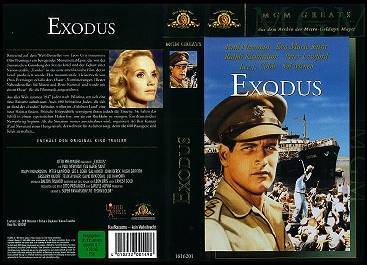
1958, Exodus exploded onto the scene. Published by Doubleday &
Company, it soon became the largest bestseller in the United States since
Gone with the Wind. Uris had sold its film rights in advance, and it was
turned into a musical in 1971. In
1958, Exodus exploded onto the scene. Published by Doubleday &
Company, it soon became the largest bestseller in the United States since
Gone with the Wind. Uris had sold its film rights in advance, and it was
turned into a musical in 1971. In researching the book, Uris
traveled widely throughout Israel, interviewing more than a thousand people
while gathering resources. The book dealt with the struggle to
establish and defend the state of Israel. Although the founding of
Israel was seen through the eyes of numerous characters, the heart of the
book is the story of an American nurse and an Israeli freedom fighter.
Otto Preminger brought the work to the big screen.
 After
the enormous success of Exodus, Uris traveled throughout Eastern
Europe, collaborating with Greek photographer Dimitrios Harissiadis on Exodus
Revisited (1960) about places that were mentioned in the previous
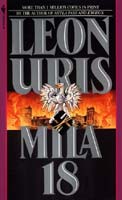
bestseller. The following year, he published Mila 18 (1961),
which took place during the Warsaw ghetto uprising against the Nazis in
1943. The title of the novel referred to the address of the command
post for the Jewish resistance in the city and forced Joseph Heller to
change the title of his anti-war black comedy, Catch-18, to
Catch-22 (1961). After
the enormous success of Exodus, Uris traveled throughout Eastern
Europe, collaborating with Greek photographer Dimitrios Harissiadis on Exodus
Revisited (1960) about places that were mentioned in the previous
bestseller. The following year, he published Mila 18 (1961),
which took place during the Warsaw ghetto uprising against the Nazis in
1943. The title of the novel referred to the address of the command
post for the Jewish resistance in the city and forced Joseph Heller to
change the title of his anti-war black comedy, Catch-18, to
Catch-22 (1961).
In 1964, Uris and his British publisher, Bantam, were sued
for libel by a Polish doctor, Wladislaw Dering, claiming that Uris had
defamed him by name, calling him one of the surgeons who had committed
atrocities against the Jews at Auschwitz. Although the court decided
in favor of the doctor, it ordered the victor to pay the legal costs of both
sides and Uris to pay the doctor a halfpenny for damages. Ever the
opportunist, Uris turned the trial into the novel, Q. B. VII (1970), a
look into Britain's legal practices in which Dr. Adam Kelno sues Pulitzer
Prize winning author, Abraham Cady.
Three years after his divorce in 1965, Uris married Margery Edwards, who
died the next year of an apparent suicide. In 1970, the author married
photographer Jill Peabody. They had two children. She became his
chief editor and published in collaboration with Uris' books Ireland: A
Terrible Beauty (1975) and Jerusalem: Son of Songs (1981).
The couple divorced in 1989.
 The
circumstances surrounding the publication of Topaz (1967) read more
like a spy novel itself than real life. An exiled French diplomat who
opposed French President Charles de Gaulle's foreign policy showed Uris
papers containing delicate information about the French Intelligence
Service. The book's publication caused a riff within the French
government. When Alfred Hitchcock decided to adapt the book into a
movie, Uris wrote the initial screenplay. The final script was written
by Samuel A. Taylor, who had worked with the director on Vertigo.
Despite the attached talent, Hitchcock later called the film "a complete
disaster." The
circumstances surrounding the publication of Topaz (1967) read more
like a spy novel itself than real life. An exiled French diplomat who
opposed French President Charles de Gaulle's foreign policy showed Uris
papers containing delicate information about the French Intelligence
Service. The book's publication caused a riff within the French
government. When Alfred Hitchcock decided to adapt the book into a
movie, Uris wrote the initial screenplay. The final script was written
by Samuel A. Taylor, who had worked with the director on Vertigo.
Despite the attached talent, Hitchcock later called the film "a complete
disaster."
In Trinity (1976), Uris detailed the life of a family
of Northern Irish farmers from 1840 - 1916. The main
characters, a young Catholic rebel and a Protestant girl, fight for their
live in a country divided by wealth and religion. Uris continued the
Larkin family saga with The Redemption (1995), developing the theme
that love and forgiveness can triumph against all adversities.
In The Haj (1984) and Mitla Pass (1988), Uris returned
to the familiar themes of upheaval in the Middle East. He jumped from
familiar territory into the unknown in 1999 with the publication of A God
in Ruins, which unfolded in flashbacks and set in the United States on
the eve of the 2008 presidential election. Uris's last novel was
O'Hara's Choice (2003).
Leon Uris, who once said, "Often we have no time for our
friends but all the time in the world for our enemies," died of renal
failure on June 21, 2003, at his home on Shelter Island, N.Y.
 Discover Leon Uris
at Amazon.com
Indulge
Yourself - Check Out Today's Best-Selling
Fiction -
Nonfiction -
DVDs |