|
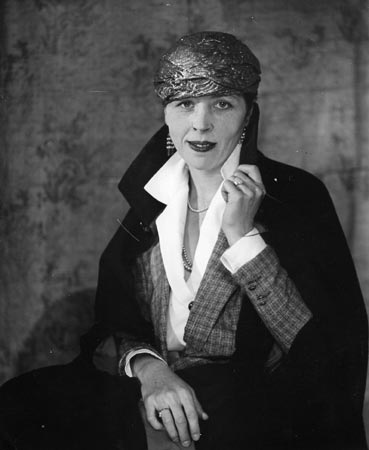
Djuna Barnes
 A
legendary event unfolded on June
12, 1892, a day that not coincidentally marks the birthday of Djuna Barnes. Born in
Cornwall-on-Hudson, New York, she was destined to become a mover and a
shaker in the world of arts and literature, to skyrocket to the summit of
social prominence and to fade nearly as quickly into virtual oblivion.. A
legendary event unfolded on June
12, 1892, a day that not coincidentally marks the birthday of Djuna Barnes. Born in
Cornwall-on-Hudson, New York, she was destined to become a mover and a
shaker in the world of arts and literature, to skyrocket to the summit of
social prominence and to fade nearly as quickly into virtual oblivion..
Her father was the wealthy and
free-spirited Henry Budington ("Wald") Barnes, an obscure artist who ran a farm on Long Island. Her mother was Elizabeth Chappel Barnes, an English-born violinist.
Barnes was raised by her mother and her suffragist
grandmother. She and the four other children of the family were taught
outside of the conventional school system. Her father influenced her
development as an artist. She may have suffered some psychosexual or
sexual abuse at home: her works include visions of love that contain
elements of incest.
 In
1911, Barnes entered the Pratt Institute in Brooklyn. She also studied
for a while at the Art Students League. After her parents divorced, she
took a job as a journalist and a freelance illustrator. She lived a
typically Bohemian life in Greenwich Village and wrote for several New York
newspapers, including the Brooklyn Eagle. A collection of her
interviews of several sports and arts celebrities, including Diamond Jim
Brady, Florenz Ziegfeld, Frank Harris, and D. W. Griffiths, was published
posthumously as Interviews. In
1911, Barnes entered the Pratt Institute in Brooklyn. She also studied
for a while at the Art Students League. After her parents divorced, she
took a job as a journalist and a freelance illustrator. She lived a
typically Bohemian life in Greenwich Village and wrote for several New York
newspapers, including the Brooklyn Eagle. A collection of her
interviews of several sports and arts celebrities, including Diamond Jim
Brady, Florenz Ziegfeld, Frank Harris, and D. W. Griffiths, was published
posthumously as Interviews.
A versatile woman of extreme curiosity, Barnes was always
out to advance her knowledge of the world around her through trial and
error. In 1915, she published a collection of poems and drawings
entitled The Book of Repulsive Women.
Three of her one-act plays were produced in 1919-20 at the
Provincetown Playhouse in the Village, where she worked with Eugene O'Neill.
Her marriage to editor Courtenay Lemon lasted only briefly.
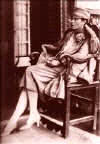 Barnes
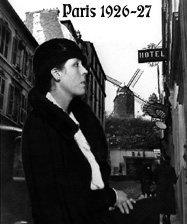
went to Paris in 1920, where she befriended several prominent writers,
including T. S. Eliot, Gertrude Stein, Ezra Pound, F. Scott Fitzgerald, and
James Joyce. She produced her second collection of poems and
drawings, A Book, in 1923. In the early 1920s, she began
drinking heavily. She was hospitalized several times in New York.
She lived with sculptor and silverpoint artist Thelma Wood, publishing
anonymously Ladies Almanack
(1928), an erotic canvas of lesbian
life. It was arranged by month and was illustrated with the author's
own drawings. Barnes
went to Paris in 1920, where she befriended several prominent writers,
including T. S. Eliot, Gertrude Stein, Ezra Pound, F. Scott Fitzgerald, and
James Joyce. She produced her second collection of poems and
drawings, A Book, in 1923. In the early 1920s, she began
drinking heavily. She was hospitalized several times in New York.
She lived with sculptor and silverpoint artist Thelma Wood, publishing
anonymously Ladies Almanack
(1928), an erotic canvas of lesbian
life. It was arranged by month and was illustrated with the author's
own drawings.
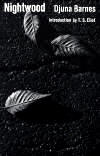 She said in 1922, after
reading Joyce's Ulysses,
"I shall never write another line. Who has the
nerve to after that?" Thankfully, she failed to live up to her
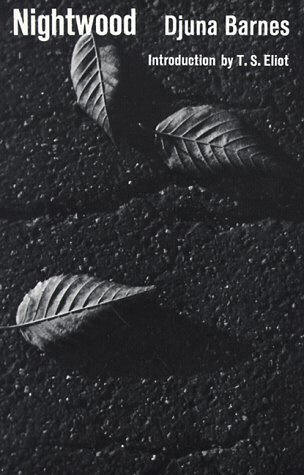
commitment and did write again, publishing Nightwood in
1936. It's an experimental novel about a woman named Nora Flood, her
love affairs, and her spiritual mentor, a transvestite named Dr. O'Conner. She said in 1922, after
reading Joyce's Ulysses,
"I shall never write another line. Who has the
nerve to after that?" Thankfully, she failed to live up to her
commitment and did write again, publishing Nightwood in
1936. It's an experimental novel about a woman named Nora Flood, her
love affairs, and her spiritual mentor, a transvestite named Dr. O'Conner.
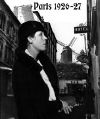 The
book was rejected by all of the American publishers to whom she submitted
it. But T. S. Eliot loved it, and he influenced publishers Faber & Faber to produce
it. Eliot wrote the introduction. It had a great influence on
many later experimental writers of the 1950s and '60s and has since gone on
to become a cult classic. The
book was rejected by all of the American publishers to whom she submitted
it. But T. S. Eliot loved it, and he influenced publishers Faber & Faber to produce
it. Eliot wrote the introduction. It had a great influence on
many later experimental writers of the 1950s and '60s and has since gone on
to become a cult classic.
Barnes produced only one major work after Nightwood.
In 1958, The Antiphon, a play written in a highly artificial style, again
explored the subject of incestuous family relationships. This time, a
daughter resolves her conflict with her mother. The play was staged in
1962 in Stockholm, translated by Karl Ragnar Gierow and then Swedish U.N.
Secretary-General Dag Hammarskjöld, who was killed in an airplane crash in
1961.
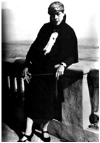 In
1931, Barnes went to England, where she spent time as the guest of Peggy
Guggenheim. At the outbreak of World War II, she returned to Greenwich
Village, where the following year her works were exhibited at Art of This
Century. In 1961, she was elected to the National Institute of Arts
and Letters. In
1931, Barnes went to England, where she spent time as the guest of Peggy
Guggenheim. At the outbreak of World War II, she returned to Greenwich
Village, where the following year her works were exhibited at Art of This
Century. In 1961, she was elected to the National Institute of Arts
and Letters.
"Growing old is just a matter of throwing life away," she once said,
"so you finally
forgive even those that you have not begun to forget."
Djuna Barnes lived out her remaining years quietly in an apartment at 5 Patchin Place until
her death on June 18, 1982. Despite the interest in her work by a few
scattered feminists
during the 1970s and 1980s, she remains the unknown legend of
American literature.

Discover Djuna Barnes
at Amazon.com
Indulge
Yourself - Check Out Today's Best-Selling
Fiction -
Nonfiction -
DVDs |