|
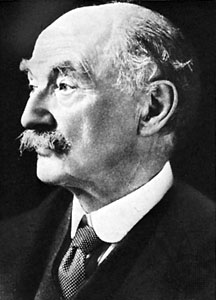
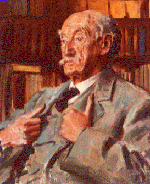
Thomas Hardy
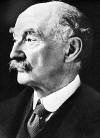 June
2, 1840, marks the birthday of novelist and poet
Thomas Hardy, who was born
on the Egdon Heath in Dorset, near Dorchester, England.
Dorset was a poor, rural county where life hadn't
changed very much for hundreds of years, and older people spoke a local
dialect similar to German. Hardy's father was a master mason
and building contractor. His mother, whose tastes included Latin
poets and French romance writers, provided for his education. June
2, 1840, marks the birthday of novelist and poet
Thomas Hardy, who was born
on the Egdon Heath in Dorset, near Dorchester, England.
Dorset was a poor, rural county where life hadn't
changed very much for hundreds of years, and older people spoke a local
dialect similar to German. Hardy's father was a master mason
and building contractor. His mother, whose tastes included Latin
poets and French romance writers, provided for his education.
 Following
his schooling in Dorchester, Hardy worked as an apprentice to an architect
who specialized in the restoration of old churches.
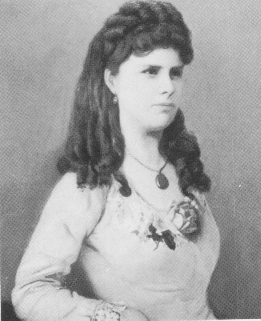
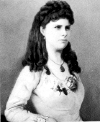
In 1874, he married Emmah Lavinia Gifford, for whom he wrote after her
death 40 years later a group of poems known as Veteris Vestigiae Flammae
(Vestiges of an Old Flame). Hardy
often stayed up late into the night reading poetry and magazines and listening to his grandmother
tell stories about the times of Napoleon. Following
his schooling in Dorchester, Hardy worked as an apprentice to an architect
who specialized in the restoration of old churches.
In 1874, he married Emmah Lavinia Gifford, for whom he wrote after her
death 40 years later a group of poems known as Veteris Vestigiae Flammae
(Vestiges of an Old Flame). Hardy
often stayed up late into the night reading poetry and magazines and listening to his grandmother
tell stories about the times of Napoleon.
Before long, Hardy became more interested in poetry than in architecture, and he
began rising each morning to study Latin and Greek. When he turned 22,
he moved to London, where he began writing his own poetry. But he
couldn't find a publisher for his work, so he decided to try his hand at
writing novels. His first
book, Desperate Remedies, was published anonymously in 1871.
His first big success was Far from the Madding Crowd, published in
1874. He went on to write The Return of the Native (1878), Tess of the D'Urbervilles (1891) and Jude the Obscure (1895),
becoming one of the most popular novelists of his time.
 Most
of Hardy's novels were initially published as serials in popular magazines,
as was often the case in the late 1800s. He was careful not to write
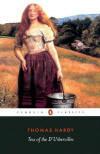
anything that the general public might consider offensive. But when he published Tess of the D'Urbervilles in
book form, he included several chapters that had been withheld from the
magazine version. Most
of Hardy's novels were initially published as serials in popular magazines,
as was often the case in the late 1800s. He was careful not to write
anything that the general public might consider offensive. But when he published Tess of the D'Urbervilles in
book form, he included several chapters that had been withheld from the
magazine version.
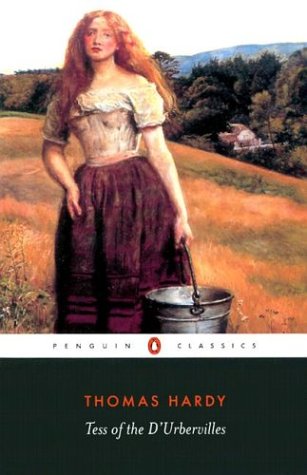
In the book, the poor villager girl Tess Durbeyfield is seduced by
the wealthy Alec D'Uberville. She becomes pregnant, but the child dies
in infancy. Tess finds work as a dairymaid on a farm and falls in love
with Angel Clare, a clergyman's son. They eventually marry, but when
she tells him about her past, he desert her. In order to survive, Tess
becomes Alec's mistress. Angel returns from Brazil, repenting his
harshness, but when he finds her living with Alec, he kills the older man,
and she is arrested and hanged.
Hardy portrayed the woman
sympathetically and gave the novel the subtitle, "A Pure Woman Faithfully
Presented." Critics called the book shameless and immoral. A
bishop publicly condemned the book and burned it in effigy while convincing
local bookstores to remove it from their shelves.
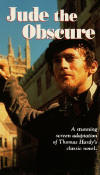 Hardy's
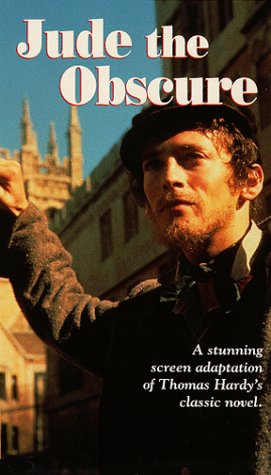
next work, Jude the Obscure (1895),
generated even more controversy. The story dramatizes the
conflict between carnal and spiritual life, tracing Jude Fawley's history
from boyhood to his early death. Jude marries Arabella, but afterwards
he deserts
her. He falls in love with his cousin, the flighty Sue Bridehead, who
marries the decaying schoolmaster, Phillotson. Jude and Sue obtain
divorces, but their lives together deteriorate under the pressures of poverty
and social disapproval. The eldest son of Jude and Arabella, a
grotesque boy nicknamed Father Time, kills their children and himself.
Heartbroken at the loss, Sue returns to Phillotson, and Jude reunites with
Arabella. Hardy's
next work, Jude the Obscure (1895),
generated even more controversy. The story dramatizes the
conflict between carnal and spiritual life, tracing Jude Fawley's history
from boyhood to his early death. Jude marries Arabella, but afterwards
he deserts
her. He falls in love with his cousin, the flighty Sue Bridehead, who
marries the decaying schoolmaster, Phillotson. Jude and Sue obtain
divorces, but their lives together deteriorate under the pressures of poverty
and social disapproval. The eldest son of Jude and Arabella, a
grotesque boy nicknamed Father Time, kills their children and himself.
Heartbroken at the loss, Sue returns to Phillotson, and Jude reunites with
Arabella.
Hardy had always looked at writing novels as a way of making money, but when
the critics turned against him, he decided never to write fiction again.
He had been writing poetry for over thirty years, and now that he had become
a famous novelist, he was able to publish much of what he had written.
In April, 1912, Hardy wrote:
"Then somebody discovered that Jude was a moral work -
austere in its treatment of a difficult subject - as if the writer had not
all the time said in the Preface that it was meant to be so. Thereupon
many uncursed me, and the matter ended, the only effect of it on human
conduct that I could discover being its effect on myself - the experience
completely curing me of the further interest in novel-writing."
His first collection of poems,
Wessex Poems, was published in 1898. True to his word, Hardy
published nothing other than poetry for the remaining thirty years of his
life. His Collected Poems came out in 1930.
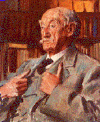 Thomas
Hardy died in Dorchester, Dorset, on January 11, 1928. His remains were
cremated in Dorchester and buried with impressive ceremonies in the Poet's
Corner in Westminster Abbey. But even in death, the cursed novelist
found little peace. According to legend, his heart was to be buried
in Stinsford, his birthplace. As plans were being made, a cat
belonging to Hardy's sister snatched the heart from the kitchen, where it
was being kept, and disappeared into the woods with it. Thomas
Hardy died in Dorchester, Dorset, on January 11, 1928. His remains were
cremated in Dorchester and buried with impressive ceremonies in the Poet's
Corner in Westminster Abbey. But even in death, the cursed novelist
found little peace. According to legend, his heart was to be buried
in Stinsford, his birthplace. As plans were being made, a cat
belonging to Hardy's sister snatched the heart from the kitchen, where it
was being kept, and disappeared into the woods with it.

Discover Thomas Hardy
at Amazon.com
Indulge
Yourself - Check Out Today's Best-Selling
Fiction -
Nonfiction -
DVDs |