|
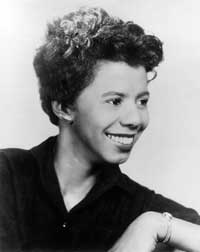
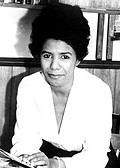
Lorraine Hansberry
 One-hit wonders come and go. But of them all, American
playwright Lorraine Hansberry deserves the
most respect. Born in Chicago on May 19, 1930, she is best known for
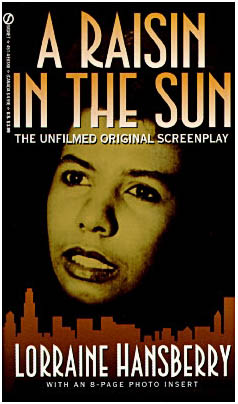
her play, A Raisin in the Sun
(1959), about a black American
family living on the South Side of Chicago. The play was
remarkable for its time in that it featured an all-black cast in an all-black setting
during racially charged times, virtually guaranteeing that it would be ignored by a
mostly white society. Yet, the very power of the play allowed it to rise
above all obstacles. One-hit wonders come and go. But of them all, American
playwright Lorraine Hansberry deserves the
most respect. Born in Chicago on May 19, 1930, she is best known for
her play, A Raisin in the Sun
(1959), about a black American
family living on the South Side of Chicago. The play was
remarkable for its time in that it featured an all-black cast in an all-black setting
during racially charged times, virtually guaranteeing that it would be ignored by a
mostly white society. Yet, the very power of the play allowed it to rise
above all obstacles.
Hansberry grew up in a middle-class family in the Windy City at a time when
neighborhoods were still racially segregated. When she was eight years
old, her father, a real-estate broker, had a white friend buy a
house for him in an all-white neighborhood. A few weeks after the
Hansberrys
moved in, they were attacked by an angry mob. Lorraine narrowly
escaped
being hit by a brick thrown through her bedroom window. Her father
took the case to the Illinois Supreme Court, and his victory there in 1959
paved the way for racial desegregation in cities across the country.
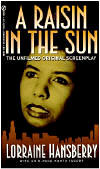 It was that experience that gave Hansberry the idea for
A Raisin in the Sun.
She told her husband that she wanted to write a social drama
about blacks in America, but she also wanted it to stand on its own merits as a
work of art. She was tired of seeing blacks portrayed as cardboard
characters with stereotypical dialect, so she wrote a play about the Younger
family, who live in a cramped house on Chicago's bustling South Side.
When they receive a 10,000-dollar life insurance check, they have to decide
if they should move into a larger house in an all-white suburb or remain
where they are. The title of the play sprang from a Langston Hughes
poem called A Dream Deferred. It was that experience that gave Hansberry the idea for
A Raisin in the Sun.
She told her husband that she wanted to write a social drama
about blacks in America, but she also wanted it to stand on its own merits as a
work of art. She was tired of seeing blacks portrayed as cardboard
characters with stereotypical dialect, so she wrote a play about the Younger
family, who live in a cramped house on Chicago's bustling South Side.
When they receive a 10,000-dollar life insurance check, they have to decide
if they should move into a larger house in an all-white suburb or remain
where they are. The title of the play sprang from a Langston Hughes
poem called A Dream Deferred.
A Raisin in the Sun was Hansberry's first play.
She wrote it when
she was twenty-eight years old, and she had no idea how to go about getting
it produced. One night, after reading the first part of the play to
music publisher Philip Rose and a group
of friends, Rose volunteered to produce the play, although
he'd never produced a play in his life. But he was friends with Sidney Poitier, whom he telephoned. Poitier arranged for black director Lloyd
Richards to tackle the project.
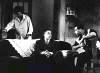 It took more than a year to raise the money necessary to
produce Raisin. Hansberry later said, "It was the conventional wisdom
that nobody was going to pay...to see a bunch of negroes emoting."
They were unable to rent a theater in New York, so they took the show on
the road. Wherever it played, it drew huge audiences. It took more than a year to raise the money necessary to
produce Raisin. Hansberry later said, "It was the conventional wisdom
that nobody was going to pay...to see a bunch of negroes emoting."
They were unable to rent a theater in New York, so they took the show on
the road. Wherever it played, it drew huge audiences.
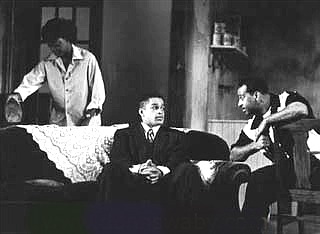
Finally, in March of 1959, the play opened on Broadway with a cast that
included Sidney Poitier, Claudia McNeil, and Louis Gossett Jr. A
preview audience gave it a lukewarm response. But the opening-night
audience loved it, and it went on to play for more than five hundred
performances during the next two years. It won the New York Drama Critics Circle
award for best American play of 1959, despite the fact that Tennessee
Williams, Eugene O'Neill, and William Faulkner each had a play on Broadway
that year.
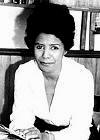 A Raisin in the Sun was the first Broadway play to be written by a
black woman. It was the first play that most audience members saw
portraying the life of a normal black family on stage or in
film. For blacks, it opened the door for actors and directors to
produce more plays on Broadway. Over the next six years,
five Broadway productions by black playwrights using mostly black casts
premiered.
The play inspired a new generation of black playwrights that included August
Wilson and Ntozake Shange, and it helped to spawn several black theater
troupes in the 1960s and '70s. A Raisin in the Sun was the first Broadway play to be written by a
black woman. It was the first play that most audience members saw
portraying the life of a normal black family on stage or in
film. For blacks, it opened the door for actors and directors to
produce more plays on Broadway. Over the next six years,
five Broadway productions by black playwrights using mostly black casts
premiered.
The play inspired a new generation of black playwrights that included August
Wilson and Ntozake Shange, and it helped to spawn several black theater
troupes in the 1960s and '70s.
In 1961, the play was made into a movie, with most of the
original cast. In 1973, it was made into a Tony award-winning musical;
and, in 1989, it was produced for television. Today, it's used in many
schools to teach playwriting techniques, and it's performed regularly in
regional theaters.

Discover Lorraine Hansberry
at Amazon.com
Indulge
Yourself - Check Out Today's Best-Selling
Fiction -
Nonfiction -
DVDs |