It Happened
in History!
(Go to
It Happened in History Archives)
|
Burroughs studied English literature at Harvard, which was a calving ground for many of the writers who took their place in the Beat hall of fame. He did graduate work in ethnology and archaeology and worked a variety of jobs during World War II. He was a plain-clothes detective, exterminator, advertising copywriter, factory worker, bar attendant, and waiter. While drifting from job to job, he met Lucien Carr, Jack Kerouac, and Allen Ginsberg in New York City around Christmas 1943, shortly after Ginsberg began studying at Columbia. Burroughs impressed them with his scholarship, as well as his sardonic sense of humor and the reserved poise that often comes with a wealthy birthright.
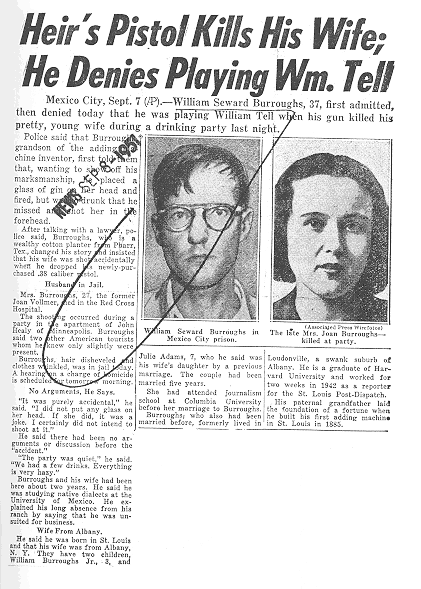
Early in his writing career, Burroughs collaborated on a humorous sketch with a Harvard classmate, Kells Elvins, and on a short Dashiell Hammett-style novel with Kerouac, but publishers rejected both works, and Burroughs began to doubt his own literary talents. His continuing search for an identity led him to seek out the criminal elements in society. Hoping to fit in with a "community of outlaws," he began buying stolen goods, including morphine, and in 1944, he became addicted to the drug. In 1947, he moved in with Joan Vollmer, another member of the group around the Columbia campus, and she gave birth to their son, William S. Burroughs, Jr. Joan, too was an addict, making Benzedrine her drug of choice. The couple moved to New Orleans, Texas, and Mexico City in order to obtain their drugs more easily. In the spring of 1950, Elvins visited Burroughs in Mexico City and talked him into writing a factual book about his drug experience as a "memory exercise." Burroughs set a daily schedule and mostly kept to it with the help of daily injections of morphine. He finished the project in December and titled his book Junky. He sent the manuscript to Lucien Carr in New York. Finally, Ginsberg obtained a copy and was able to get the book published as a pulp paperback in 1953 under the pseudonym "William Lee." The cover sported the lurid subtitle, Confessions of an Unredeemed Drug Addict.
Released on bail, Burroughs left Mexico and traveled throughout South America looking for a drug called yage. His letters to Ginsberg describing his experiences in the cities, jungles, and mountains of Ecuador and Peru were collected in a volume later published by City Lights as The Yage Letters (1963). Burroughs thought the pieces would interest the same readers who had made Aldous Huxley's The Doors of Perception (1954) so successful. After Burroughs left South America, he settled in Tangier, where he found he could live cheaply and obtain the drugs he needed for his very survival. His wife's death created in him a type of literary urgency. He felt that he had been possessed by an invader, "the Ugly Spirit," who controlled him at the time of the accident and maneuvered him into a lifelong struggle, "in which I have had no choice except to write my way out." In 1957, Kerouac visited Burroughs in Tangier and began to type the hundreds of handwritten pages of Burroughs' new book, which Kerouac titled Naked Lunch. Afterwards, Burroughs said he was "shitting out my educated Middlewestern background once and for all. It's a matter of catharsis, where I say the most horrible things I can think of. Realize that--the most horrible dirty smelly awful niggardliest posture possible...."
After leaving Tangier in 1957, Burroughs traveled to London to enroll in apomorphine treatment--still banned in the U.S.--for his drug addiction. The treatment failed, and he slipped back into his more familiar ways. Burroughs found the English literary scene to be terminally depressing. "England has the most sordid literary scene..." he said. "They all meet in the same pub. This guy's writing a foreword for this person. They all have to give radio programs, they have to do all this just in order to scrape by. They're all scratching each other's backs."
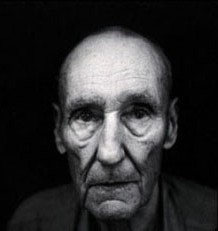
Burroughs kept a daily journal with three separate columns in it. In one, he wrote what he was doing. In the second, he wrote what he was thinking. And in the third, he wrote what he was reading. He carried with him notebooks, news clippings, and photographs, as well as scissors, paste, and a tape recorder--all of which he considered part of his writing tools. "In my writing," he said, "I am acting as a map maker, an explorer of psychic areas...a cosmonaut of inner space, and I see no point in exploring areas that have already been thoroughly surveyed." In his later life, Burroughs moved to a small two-bedroom cottage in Lawrence, KS, where he lived with his cats. He took up painting and collage, turning out abstract works of art characterized as expressive surrealism. Devoted to truth in all the arts, Burroughs said, "So cheat your landlord if you can and must, but do not try to shortchange the Muse. It cannot be done. You can't fake quality any more than you can fake a good meal." William S. Burroughs died in Lawrence at 6:50 p.m. on August 2, 1997, from complications of a heart attack he had suffered the previous day.
Discover William S. Burroughs
Indulge
Yourself - Check Out Today's Best-Selling |




- HOME -